cogKnit - Designed for Safe, Open-Ended Play.

Our design philosophy

Designed with childhood development in mind.

The early years are not simply a smaller version of later childhood. They are a period of extraordinary development - when children are building their bodies, senses, language, relationships, imagination and understanding of the world around them.

How children play matters.

Research in early childhood development consistently points to the importance of active, hands-on experiences, responsive relationships, movement, sensory exploration, pretend play, and opportunities for children to make choices and solve problems.

That's why we don't design cogKnit products simply to keep children entertained or distracted by novelty. We design them around what children are naturally trying to do: explore, move, imagine, create and make sense of their world.
Designed differently

Why cogKnit feels different

Made with fabric & texture
Soft, tactile materials invite children to touch, feel, carry, squeeze and explore.
Open-ended by design
No single right way to play. A stick can become a horse, a rolling pin or a magic wand.
Built for real childhood
Thoughtful construction, safe materials and durable details made to withstand everyday play.
Grows with imagination
The product doesn't become irrelevant when a child learns a new skill. Its possibilities change as they do.
Made to be played, not consumed
We design fewer, more meaningful objects that can be used again and again, rather than toys made for short-lived novelty.
Made by hands, not just machines
Crafted with care by women makers, giving every product a human story beyond the object itself.
Designed to leave room
We make the object. Your child makes the meaning.

Our design principles

What children need. How cogKnit responds.

Sensory exploration
Textures, weight, softness, movement and tactile materials invite children to discover through their senses.
Movement & body awareness
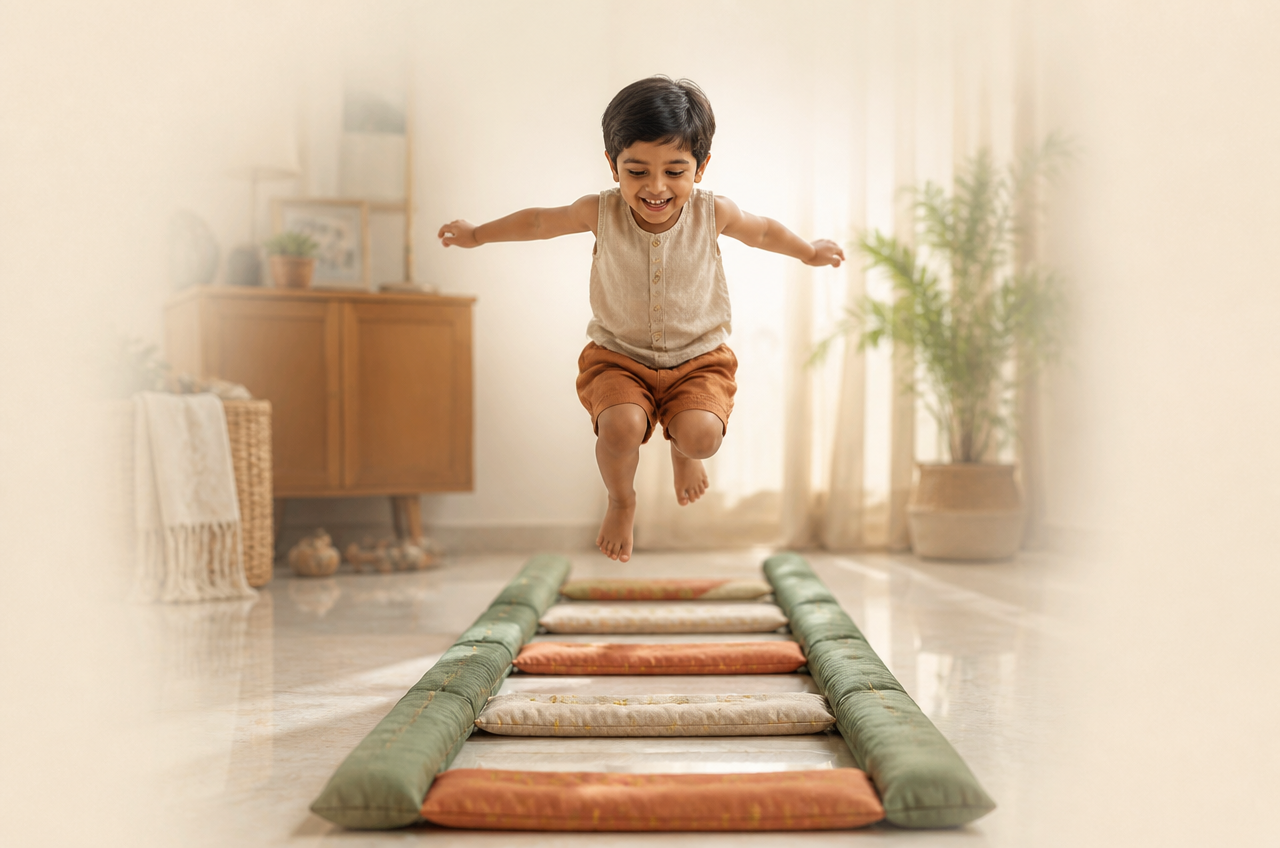
Products encourage carrying, pushing, pulling, balancing, reaching, throwing and moving through space.
Agency & choice
There is no single correct way to use the product. Children decide what happens next.
Imagination & pretend play
Simple objects can become characters, tools, places, vehicles or anything a child imagines.
Problem-solving
Children experiment, combine, construct, adapt and try again.
Language & storytelling
Open-ended objects create opportunities for children to invent stories, communicate ideas and play together.
Social connection
Many possibilities naturally invite parents, siblings and other children into shared play.
Growing complexity
The same object can offer a different kind of challenge as the child's abilities and imagination develop.
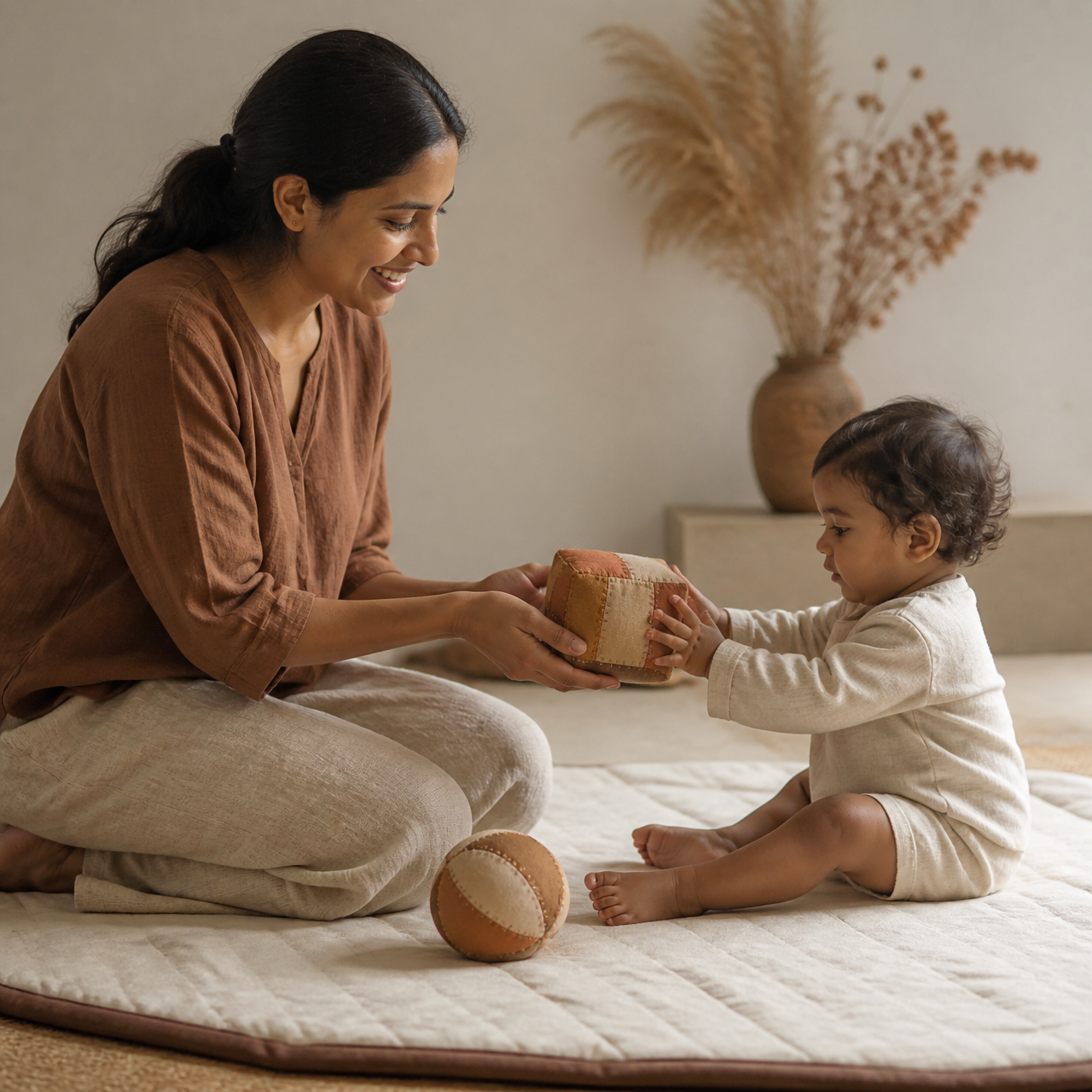
An Indian mother in loose linen trousers handing a stitched fabric discovery block to her toddler on a cream cotton floor mat

WHY COGKNIT?

What kind of world are we placing in our children's little hands?

Their beginning on this planet often starts with plastic - in the form of toys, objects and things made to entertain, engage and eventually be discarded. And unknowingly, as we fill their childhoods with more and more things, we are adding more plastic to the world they will inherit.

We don't think one play companion can solve that. But we do believe in asking a different question:

Can we make fewer things, make them more thoughtfully, and make them worth keeping?

Fabric that can be touched, loved, washed and repaired. Objects that don't become obsolete when a child discovers a new way to play. Things that can move from one phase of childhood to another.

Because the world we leave for our children is also shaped by the things we choose to put in their hands today.

Read about safety & materials →

The eight principles

Every cogKnit play companion must pass these eight principles.

01

Inspired by Real Life

Children play to understand the world they experience every day. Every product begins with a real experience - not a trend, a character, or a scripted story. Real experiences → play → understanding. One experience, one discovery and one story at a time.

02

Safe for Independent Exploration

Children deserve the freedom to explore without constant interruption. Every material, finish and construction method is chosen so a parent can say yes. Child-safe and non-toxic, washable and durable, free from unnecessary choking hazards, thoughtfully stitched rather than glued or fastened wherever possible.

03

Open-ended

A product should never tell a child what it is or what to do. One object should support hundreds of stories, uses and interpretations. The child brings the imagination; the product is only a supporting companion in that journey.

04

Awakens the Senses

Children learn with their whole bodies before they reason with their minds. We create safe, beautiful opportunities to explore texture, weight, movement, sound, rhythm and relationships - fostering observation and discovery without sensory overwhelm or rushing toward abstraction. 

05

Grows with Childhood

Great play materials aren't outgrown. A two-year-old explores through movement, a four-year-old through pretend, an eight-year-old through storytelling and construction. One object. Years of possibilities.

06

Exploration over Entertainment

Children don't need more entertainment - they need more opportunities to explore. Curiosity over consumption. Discovery over distraction. Participation over observation. Exploration over entertainment.

07

Beautifully Circular

Circularity begins at design, not at the end of a product's life. Responsibly sourced or reclaimed materials. Repairable rather than disposable. Washable and made to last. Designed to be loved, shared, repaired and passed on.

08

Accessible by Design

Accessibility means more than affordability. It means developmental value without gimmicks, complexity or waste. Thoughtfully priced, fair and transparent, inclusive by design, built to last.

The test

Every product must answer yes

  • Does it support cognition through real experiences?
  • Does it support curiosity?
  • Does it support sensory exploration?
  • Does it support independent play?
  • Does it grow with the child?
  • Does it connect to real life?
  • Would I confidently give this to my own child?

Invitation, not instruction

We send Invitation Cards instead of instruction manuals

Each card carries a simple illustration and a prompt. Questions invite exploration. Instructions often limit it.

Can you make a river?
Can you build a tunnel?
How many ways can you cross?
Can two people move together?
What does this become in your story?
What would happen if…?

What's in the name

cogKnit

Cog evokes cognition - how children think, perceive, and make sense of the world.

Knit suggests weaving together experiences, senses, relationships, imagination, and learning into a coherent whole.

Children knit together their understanding of the world through play. Every experience becomes another thread in the fabric of cognition.